






























































Changing ways of the OHL
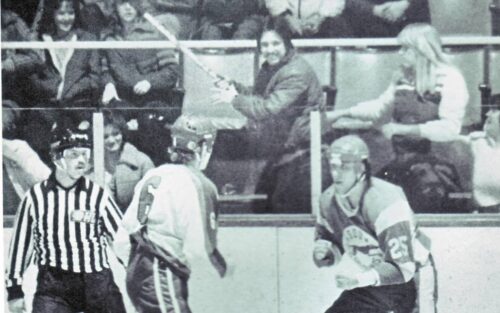

The game has unquestionably undergone major forms of change since I began covering the Ontario Hockey League back in 1975. I was just out of community college — and still wet behind the ears — when I first sat in the main press box, which was within inches of the rickety rafters of venerable Memorial Gardens in Sault Ste. Marie.
I remember the first game I covered as a long haired, 22 year old sports caster for CKCY Radio. It was opening night of the ’75-76 OHL season and the Greyhounds were playing host to the Hamilton Fincups. It was standing room only at the gritty Gardens and the fans were anticipating a show — which they were about to get.
At the end, it seemed to matter little that the Greyhounds gave up a two goal lead and had to settle for a 4-4 tie with the visiting Fincups. What really mattered was that the Bay Street Brawlers were born under new coach Muzz MacPherson — and the Hounds more than held their own with bad boy coach Bert Templeton and the Fighting Fincups of Hamilton in what was a goon show of a game.
The fans loved it. Absolutely loved it.
Well dressed Sault Ste. Marie businessmen and their prim and proper wives were among the crowd of well over 5,000 fans. Yes, bloodthirsty fans who cheered every fight, every high stick, every slash and every elbow to the unprotected head in a nasty showdown that actually began with a stare down between the two teams during the pre-game warmup — without a game official in sight. Back then, the pre-game skate was not monitored and both teams were on the ice at the same time.
What wasn’t there to love? Even me, as non violent a person as there is, absolutely loved the fights and the spears — and the stains of blood that the rink rats had to scrape off the ice throughout the game.
There were no assistant coaches back then. There was a manager and a coach and a trainer and a stick boy and that about summed up the hockey staff, save for the out of town scouts.
Back in ’75-76, there were 12 OHL teams. The Greyhounds, Sudbury Wolves, Ottawa 67’s, Kingston Canadians, Oshawa Generals and Peterborough Petes made up the Leyden Division. Hamilton, the London Knights, Toronto Marlboros, Kitchener Rangers, St. Catharines Blackhawks and the expansion Windsor Spitfires comprised the Emms Division.
Games were high scoring back then. Scores of 10-5, 12-2, 8-6, 8-4 and 7-3 were the norm. Fights were plentiful — three or four or five or more in any one game was routine. Bench clearing brawls were common place. As much as star players and workhorse goalies were coveted, goons were just as valuable, if not more.
The local media was very visible in every city. There was coverage from locally owned radio, television and newspaper outlets in every city, except maybe Toronto.
Not much changed through the 1980s. There was still an emphasis on toughness that translated to violence. If the average team didn’t have at least two or three enforcers — aka goons — they were not going to get very far.
How times have changed in the OHL.
There are 20 teams now. Every team has multiple coaches. Fighting has all but disappeared. Games are way more low scoring as there is more emphasis on systems and skill. Player equipment has changed — especially pertaining to goalies.
And remember how Cooperalls were supposed to change the game?
It is so much about adaptability. How a team changes with the times. How a league changes with the times. How obstacles and adversity are overcome.
Which brings us to how the National Collegiate Athletic Association seems intent on taking over from the OHL atop the power broker chart. It is how the OHL adapts to this changing landscape that will define it not only now but in the years ahead.
Change is a big word. Change can be scary. But never underestimate the power and the resolve of the OHL as part of the Canadian Hockey League.
Buckle up.


Todd Gill and Jim Aldred squaring up.
yep.
They were some pretty tough dudes back in the glory days, not so much now. Most players now are so fast that I think the officials have a difficult time keeping up with the pace. Some skill of course, but lots of dumping and chasing. Ron Pyette Sr